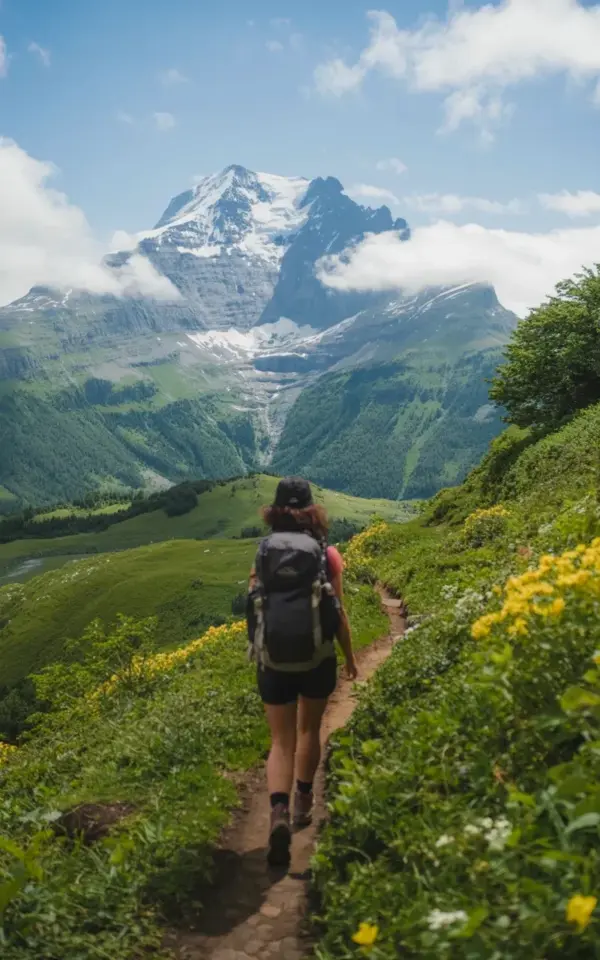
I stood on the trail for a full minute before I even moved. The yellow wildflowers stretched out like someone had spilled a bucket of sunshine across the path, and straight ahead, that massive snow-capped peak just sat there, silent and absurdly dramatic. Honestly, I’d seen the photo online, but being there on this wildflower hiking trail felt like walking into a postcard that had been cranked up to eleven. The contrast was ridiculous: warm green meadows, bright blooms, cold white rock, all under a sky so blue it hurt. I was solo, backpack cinched, and I had no idea the trail would give me that exact gut-punch of beauty. Not gonna lie, I almost cried.
Why This Wildflower Hike to a Snowy Summit Feels So Different
Most summer hikes give you one thing: green. Green trees, green bushes, maybe a green lake if you’re lucky. But here, you get this weird collision of seasons. The lower trail is pure July, buzzing with bees and heat, and then you look up and see winter still hanging on. That’s the magic of a wildflower hike to a snowy summit in the middle of summer. It’s like the mountain forgot to check its calendar.
I remember sitting on a boulder about half a mile in, watching the clouds roll around the base of the peak. They weren’t covering the summit, just sort of hugging its lower shoulders. Made the whole thing look even bigger. I was sweating in my black hiking shirt, but the air had that cool edge that reminded me I had a puffy jacket in my pack for the top. You don’t get that on a normal trail. You get confusion between your skin and your eyes. I love that confusion.
What to Wear for a Summer Hike with Snow at the Top
Ok so, I messed this up on my first try. I wore shorts and a tank, thinking, “It’s July, genius.” By the time I hit the treeline, I was freezing and my legs looked like raw chicken. Not great. So for this hike, I actually planned. I had on black hiking pants (stretchy, breathable), a long-sleeve merino top, and a light windbreaker I could tie around my waist. The woman in the photo you saw? That’s me. Dark backpack, black gear.
The trick is layers you can ditch fast. You’ll be sweating through the meadow section, then you hit the switchbacks and suddenly you’re digging out gloves. I brought a thin fleece and a beanie. Did I look ridiculous? Yes. Did I care? No, because the peak was right there, and I was warm. Summer hiking gear for alpine conditions isn’t complicated, just don’t be an idiot like I was last year. Bring an extra layer even if the parking lot feels like an oven.
Also, my boots. I wore mid-height trail runners with good grip. The dirt path was dry but there were loose rocks near the snow patches. I saw one guy in sneakers sliding around like a cartoon character. Don’t be that guy.
The Best Time of Day for Wildflower Hiking and Mountain Views
I started at 6:45 AM. Look, I’m not a morning person. I had to bribe myself with coffee and a pastry. But here’s the thing: the light at that hour makes the yellow flowers glow. It’s soft, golden, no harsh shadows. And the peak? The snow was catching the first rays while the lower slopes were still in shadow. The contrast exploded. If you care about best time for wildflower hiking and actually seeing the mountains without haze, go early.
By 10 AM, the trail was packed. Groups with bluetooth speakers, kids crying, a dog that tried to trip me. The flowers still looked nice, but the clouds had started building over the peak, and by noon you couldn’t see the top at all. So yeah, suffer the early alarm. It’s worth it for that half-hour of quiet when it’s just you, the blooms, and the big snowy wall ahead.
And if you’re shooting photos? The morning light does more for those yellow petals than any filter. I snapped a few with my phone, but honestly, nothing captures the smell. That mix of warm pine, damp earth, and something sweet from the flowers. You just have to be there.
How to Handle the Contrast: Warm Meadows and Cold Peaks
This is the part that gets people. You’re walking through a meadow that feels like summer camp, and then you round a corner and the trail goes straight up into a snowfield. My legs were not ready. I had to stop, take off my windbreaker, then put it back on, then take it off again. It’s annoying. But there’s a way to manage it: plan your breaks by elevation, not by time.
Alpine meadow hiking tips that actually work: when you hit the first patch of snow, stop and layer up before you start shivering. Don’t wait until you’re cold. Also, bring a trash bag to sit on if you want to rest on damp ground. I used mine as a butt pad and suddenly I was the most popular hiker on the trail when everyone else was just squatting awkwardly. You’re welcome.
The meadow part is easy, mostly flat with gentle ups. The real work starts when the trail gets rocky and you see the peak looming way too close. I took it slow, one foot in front of the other, and used my hands on a few steep scrambles. The snow patches were firm in the morning, slushy by afternoon. Microspikes? I didn’t use them this time, but I could have. If you go late in the day, bring them.
A Few Things Nobody Tells You About Solo Hiking Like This
I hike alone a lot. Not because I’m a badass, but because I can’t coordinate schedules with anyone. Solo women hiking gets a lot of “be careful” advice, and yeah, you should be smart about it, but nobody tells you how weirdly peaceful it is to have nobody talking to you for six hours. You process things. I thought about a rejection email I got three years ago. I thought about what kind of sandwich I wanted for lunch. I thought about how the yellow flowers seemed to point at the peak like arrow signs. Deep stuff.
One thing that surprised me: the silence. Even with other hikers around, when you’re alone, the sounds become sharper. The crunch of gravel under my boots, the buzz of a fly that kept circling my head, the distant trickle of meltwater. It’s not lonely. It’s just you and the mountain having a conversation you don’t quite understand.
Also, nobody tells you that you’ll have to pee in a bush while trying not to crush wildflowers. It’s a skill. I failed twice.
The Wildflowers Themselves: Yellow Blooms and Other Surprises
I’m not a botanist, so I can’t tell you the exact species. But those yellow flowers were everywhere, lining the first two miles like a golden carpet. Some were tall with multiple petals, some were low and clustered. And then, mixed in, I spotted tiny purple ones and white ones with jagged edges. They looked like something a toddler would draw. I stopped to photograph a bee that was practically drunk on pollen. You could hear it buzzing from three feet away.
I did some half-hearted research later. I think the yellow ones are arnica or maybe mule’s ears? Honestly, I don’t care. They were there. They made the trail look like a fairy tale. And when the wind picked up, the whole field swayed like a wave. I stood there for maybe five minutes, just watching. That’s the kind of moment you can’t plan for. Identifying alpine wildflowers? Not my strong suit. But appreciating them? That, I can do.
Why This Trail Belongs on Your Summer Hiking Bucket List
Look, I’ve done a lot of hikes. Some are good for views, some are good for flowers, very few give you both in one afternoon. This one does, and it does it without being a soul-crushing elevation gain. It’s hard enough to feel like you earned the summit, but not so hard that you hate yourself. That sweet spot is rare. That’s why it’s on my summer hiking bucket list and why I’ll probably do it again next year.
If you’re a woman who hikes alone, or even if you drag a friend, this trail respects your time. It gives you beauty early, then rewards you with a peak that makes you feel small in the best way. The yellow flowers, the snowy cap, that blue sky. It’s like the mountain knows you need a break from everything else.
Save this for your next solo adventure. Trust me, you’ll want to remember the way the yellow blooms pointed straight at that snowy peak.
#hikingtrail #wildflowerhike #mountainviews #summerhiking #womenwhohike
Leave a Comment